At the source of Mandinka music
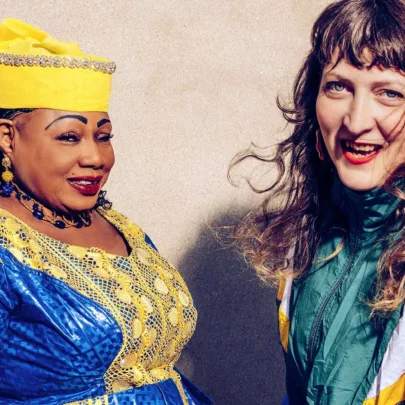
with Naïny Diabaté and Eve Risser
in partnership with the Quai Branly-Jacques Chirac Museum
Period
From August 17 to 29, 2027
Presentation
In 2027, the Transcultural Music Campus will bring together around ten artists , led by Naïny Diabaté and Eve Risser, eager to explore Mandinka heritage, collective improvisation, and contemporary forms of creation based on listening, orality, and co-composition. For two weeks, participants will be invited to experiment with new ways of creating together at the crossroads of living musical traditions from West Africa and current practices in jazz, improvisation, and collective creation.
Organised by the Royaumont Foundation in partnership with the Musée du quai Branly – Jacques Chirac , the Campus Musiques transculturelles invites each year two artistic personalities with complementary trajectories: an artist from a living musical tradition and an artist committed to the invention of new forms of creation and dialogue between cultures.
Conceived as a space for experimentation and collective research , the Campus is aimed at musicians, singers, improvisers wishing to confront their practices with other musical heritages, explore modes of transmission different from those they know and open new spaces for creation.
Oral expression, listening, rhythm, physical presence, and improvisation occupy a central place, without excluding writing and composition. Each participant is invited to bring their own musical universe to bear in order to set it in motion through contact with other practices, in a dynamic where gestures, timbres, repertoires, and imaginations meet and transform.
Mandinka heritage and contemporary creation
Rooted in the rich musical and oral traditions of West Africa, the Mandinka heritage constitutes a living patrimony in which music, spoken word, memory, and transmission are inextricably linked. Carried out particularly by griots and griottes , these practices place essential importance on improvisation, polyrhythms, interaction between musicians, and the connection between artistic creation and social life.
The Campus will be guided by two major artists whose careers each embody in their own way this connection between transmission and invention.
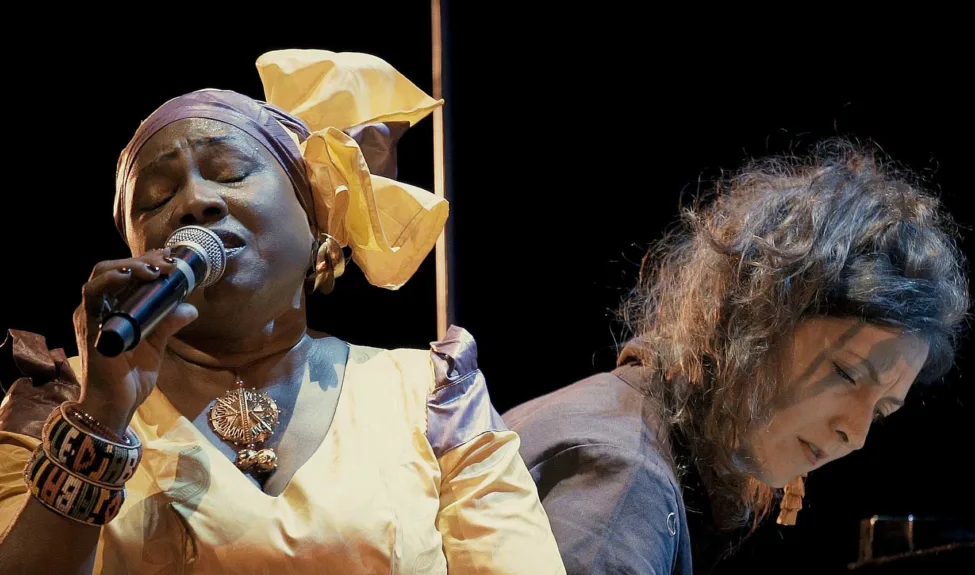
Singer and key figure in the contemporary Malian music scene, Naïny Diabaté is the heir to the great Mandinka vocal traditions . A committed activist for gender equality, she founded the first all-female orchestra in Mali, the Kaladjula Band, in order to open up a space for expression and visibility for female musicians.
Alongside him, Eve Risser has been developing a unique body of work for several years at the crossroads of contemporary writing, improvisation, and collective practices . Her musical research explores open forms of creation, the interplay between traditions and modernities, and ways of composing based on listening and otherness.
Their artistic encounter was notably embodied in the dialogue between the Kaladjula Band and Red Desert Orchestra ensembles, with the Kogoba project, bringing together artists from West Africa and Europe in the same transcultural creative approach.
What you will practice during the Campus
During the Campus, you will experience different ways of creating and performing together, drawing on Mandinka traditions and contemporary improvisation practices. You will be encouraged to:
- Develop your listening skills within a large group by learning to find your place in a complex polyphony, to articulate your playing with that of others and to build an ensemble sound.
- Discover the principles of oral transmission specific to Mandinka traditions and integrate musical materials through listening, repetition, memory and the body.
- Deepen your relationship with rhythm through ternary structures, polyrhythms and the interactions between music and dance characteristic of Mandinka practices.
- Participating in co-composition processes combining writing, improvisation and collective invention, in dialogue with Naïny Diabaté and Eve Risser.
- Explore the links between voice, instrument, movement and stage presence to enrich your own artistic practice.
Throughout the Campus, everyone will be invited to bring their personal musical universe into play in a collective process where knowledge circulates, confronts and is transformed through contact with others.
No prior knowledge of Mandinka repertoires is required. The Campus is aimed at artists already engaged in a well-established musical practice and wishing to broaden their methods of listening, transmission and creation.
Public restitutions
The Campus will alternate between group and individual music workshops, lectures, reflection sessions, and physical exercises . This immersive experience will culminate in public performances at Royaumont, the Festival des Carrières Saint-Roch, and the Musée du quai Branly – Jacques Chirac.
Like the Campus Voix Nouvelles, dedicated to written music and organised in parallel by the Royaumont Foundation, the Campus Musiques transculturelles is an invitation to create together from living memories and moving imaginations.
The framework
Supervisors
Eve Risser , pianist, composer, improviser, founder of the Desert Orchestras
Naïny Diabaté, griot, singer, bolon player, founder of the Kaladjula Band
Scientific support
Caroline Marcoux-Gendron , socio-anthropologist, associate professor in the Department of Music at the University of Quebec at Montreal (UQAM)
Occasional speakers
Elina Djebbari, anthropologist of music and dance, lecturer at the University of Nanterre – Introductory lecture (subject to change – in case of unavailability, another speaker will take the floor)
Denis Laborde , ethnologist, research director at the CNRS, director of studies at the EHESS, researcher at the Marc Bloch Centre in Berlin – Debates “The artist in society”
Jérémie Szpirglas , writer, editor, investigative journalist and lecturer – Workshops “The Keys to the Profession”: Expressing Your Artistic Identity
A representative of Sacem (Society of Authors, Composers and Music Publishers) – Workshop “The Keys to the Profession” What is the role of Sacem?
Currently recruiting – Body Practice Workshops
Learn more about…
Eve Risser is a French pianist, composer and improviser whose musical universe blends jazz, contemporary music and experimentation. Trained at a very young age in flute and piano at the Colmar conservatory, then in Strasbourg and at the Paris Conservatory, she quickly developed a free approach to improvisation and sound.
Influenced by the European improvised music scene, she joined the Orchestre National de Jazz between 2008 and 2013, a pivotal experience in her career. She also participates in the Umlaut collective, an artistic laboratory combining creation, a record label, and a festival. Her work is characterized by a poetic, political, and feminist approach, notably illustrated by her Concerto for Barbie Guitar and Symphony Orchestra, a satire of male domination in jazz.
The prepared piano became one of her preferred areas of exploration: she transformed the instrument through extensive techniques, percussive playing, and strong physical involvement. Inspired by wide-open spaces, mountains, or deserts, she created works with dreamlike atmospheres, such as Footprints in the Snow or After a Dream.
Highly active in collaborative projects, she founded the White Desert Orchestra and then the Red Desert Orchestra, blending jazz with West African influences. Through her numerous ensembles and collaborations, Eve Risser constantly seeks to break down the barriers of traditional concerts and to bring music, movement, and sensory experience closer together.
Follow Eve Risser on social media:
Naïny Diabaté, born in 1966 in Bamako, is one of the leading voices of the contemporary Mandinka tradition. From the djeli (griot) caste, she grew up in a world steeped in oral tradition. When she showed an early passion for singing, her maternal grandmother passed on to her a precious heritage of Mandinka stories, songs, and knowledge that would profoundly shape her artistic identity.
In 1977, she won a singing competition in Bamako, revealing exceptional talent. At 17, she joined the legendary Rail Band of Bamako, a true breeding ground for Malian music. Thanks to the power of her voice, her interpretive skills, and her stage presence, she quickly established herself among the country’s leading artists.
Throughout her career, Naïny Diabaté has contributed to the renewal of Mandinka music by reconciling respect for tradition with openness to contemporary influences. An accomplished singer and player of the bolon, a traditional Mandinka instrument, she brings Malian culture to the international stage.
Committed to the recognition of women in musical creation, she founded the Kaladjula Band, the first all-female Malian group bringing together musicians and singers. Her work celebrates memory, transmission, dignity, and the essential role of women in African societies. Through her journey, she embodies the alliance between ancestral heritage and modernity, carrying the richness of Malian cultural heritage far beyond its borders.
Caroline Marcoux-Gendron is an interdisciplinary researcher. She has been working on human and musical migration for over twelve years. Her research interests include the career paths and professionalization challenges faced by immigrant musicians, the role of music in the migration experience, and the work of performing arts presenters (festivals and venues) in multicultural contexts. She directs the collaborative action-research project Musique Immigration ( musique-immigration.ca ) and is co-editor of the forthcoming collective work , Participation culturelle, arts et immigration (Cultural Participation, Arts and Immigration), published in the “Monde culturel” series by Presses de l’Université Laval. She also produces the podcast Le monde dans mes oreilles (The World in My Ears ), which highlights the stories of immigrants through the lens of the music that has shaped their journeys. The second season of this podcast is entirely co-developed and co-presented with the Rencontres internationales du documentaire (International Documentary Film Festival). Alongside her research, Caroline has worked in the music industry as coordinator of the Constantinople ensemble and in charge of outreach at the Centre des musiciens du monde in Montreal (2017-2020). She also served on the Board of Directors of the Conseil des arts de Montréal as Chair of the Music Sector (2022-2025).
Denis Laborde is an anthropologist and musician. After studying at the Paris Conservatory, he taught at conservatories and worked at Radio France, where he notably conducted the world premiere of Alvin Curran’s Crystal Psalms. He then turned to anthropology and in 1993 defended his doctoral thesis at the EHESS (School for Advanced Studies in the Social Sciences) on the poetic and musical improvisations of bertsulari, the Basque improvisers. Joining the CNRS (French National Centre for Scientific Research) in 1997, he became a research director and developed an original approach to music as a tool for analyzing human societies. His research focuses on improvisation, contemporary musical creation, world music, festivals, and musical practices in the context of migration. As a director of studies at the EHESS, he founded the ARI-CNRS Institute in Bayonne, dedicated to the anthropology of music. In 2020, he received the CNRS Silver Medal for his body of work.
After a career spanning science, music, and ocean sailing, Jérémie Szpirglas now devotes himself to writing. Author of fiction ( Pater Dolorosa , Le Passeur Éditeur, 2019; Anthropocène , Publie.net, 2022), and a former cultural journalist (Le Monde de la Musique, Mouvement, editor-in-chief of Musique(s) magazine), he also lends his writing talents to various figures in the artistic and political spheres. He writes numerous reference texts for major French cultural institutions (Philharmonie de Paris, Ircam, Festival d’Automne, Ensemble intercontemporain, Théâtre des Bouffes du Nord, Opéra de Paris, Opéra-Comique, etc.). He is also the author of several books on the work of Serge Gainsbourg, notably co-authoring the definitive work: Le Gainsbook , Seghers, 2019.
Accommodation conditions
During their residency at Royaumont, the winners benefit from:
- accommodation at Royaumont Abbey in a single room with private bathroom;
- meals prepared and served by the abbey’s catering team;
- of group shuttles between Viarmes station and the abbey on arrival on August 16, 2027, and on departure on August 30, 2027.

Previous editions
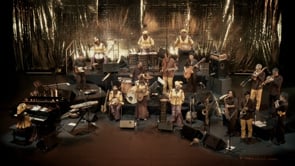
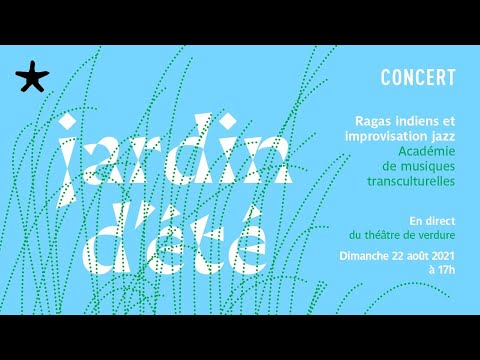
2021: Indian Ragas and Jazz Improvisation (video below)
2022: The Diwan and improvisation (video below)
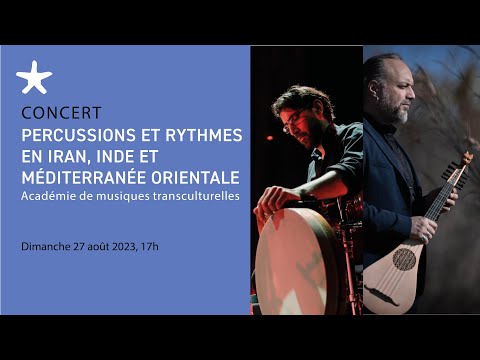
2023: Percussion and rhythms in Iran, India and the Eastern Mediterranean (video below)
2025: At the source of raï: popular song from Algeria (video below)
2026: New Orleans, the song of roots (video coming soon)


The winners talk about it
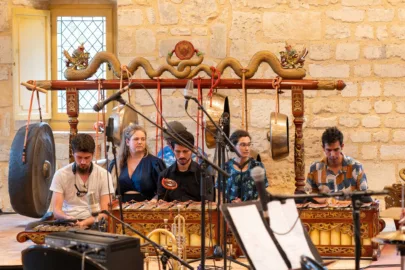
“An incredible bridge, quite moving both humanly and artistically.”
“Whether it’s the setting, the various programs, workshops and courses, the openness to aesthetics and human and musical spirit, and the encounters with different types of artists are an endless source of enrichment for an artist.”
“A very enriching and foundational training for the future.”
“It was a fantastic training course, organized and led by exceptional people, in a warm atmosphere that allowed us to focus on our work with great enthusiasm. It was a succession of highlights, the most memorable of which was the concert at the museum, where we had the chance to share our compositions with the public.”
“The training provided a total immersion in the worlds highlighted by each of the speakers, within a group of trainees of an excellent level and rich in artistic ideas.”
Course details
From August 17 to 29, 2027
Audience
10 musicians and/or singers
Prerequisites and conditions for accessing the training
Be in the final year of higher education or have relevant professional experience.
To demonstrate a stylistic openness and a taste for research and musical creation, in all its forms.
To have a regular musical practice, especially in group settings.
Having experience in improvisation.
A good level of spoken English is required. Proficiency in spoken French will be appreciated.
Participants formally commit to attending the entire training course.
Public presentations of the collective work
Saturday, August 28, 2027: presentation at Royaumont Abbey or at the Les Carrières Saint-Roch festival (Luzarches)
Sunday, August 29, 2027: return to the Quai Branly – Jacques Chirac Museum (Paris)
These presentations are an integral part of the training and are not remunerated.
Duration / schedule
From Tuesday 17th to Sunday 29th August 2027
Arrived late afternoon on August 16th at Royaumont
Departure after the public presentation on August 30th at the Quai Branly – Jacques Chirac Museum (Paris)
Number of days: 12 days of training and 1 day of rest
Number of hours: 84 hours of training
Rates
€2000 including VAT (€400 including VAT registration fee + €1600 including VAT participation fee for organization costs)
See the pricing conditions page.
Application
Selection based on application by the supervisors and the academic manager.
Required documents:
- Letter of motivation, in French or English: presentation of background, skills and qualities, reasons for wanting to participate in the Transcultural Music Campus, and expectations
- Short biography, in French or English (1000 characters including spaces)
- Curriculum vitae, in French or English
- Several video links with musical excerpts
Good sound quality is essential
File download links (WeTransfer or other) will not be accepted.
High-definition, royalty-free photo with credit mention (maximum: 100MB)
Selection calendar
Application deadline: November 15, 2026 at midnight
Result: between January 11 and 29, 2027.
In the event of an insufficient number of applications or an insufficient level of qualification, this schedule may be modified. In this case, the applicants will be informed.
All Royaumont Foundation training programs have a minimum lead time of 11 working days.
Example: if the Royaumont Foundation validates the registration request on June 14, it can offer the beneficiary a course starting on June 29.
Detailed program
August 17 [at Royaumont]
Campus Overview
Introductory lecture by a specialist on the topic of Campus
Group music practice workshop
August 18-22 [at Royaumont]
Workshops for collective, small group, or individual music practice, depending on the needs
August 23: Day off
August 24 [at Royaumont]
Workshops for collective, small group, or individual music practice, depending on the needs
August 25 [at the Quai Branly – Jacques Chirac Museum in Paris]
Presentation of a selection from the museum’s collection of instruments related to the training theme, by a speaker (researcher)
Guided tour of the Africa section of the museum’s collections gallery
August 26 and 27 [at Royaumont]
Workshops for collective, small group, or individual music practice, depending on the needs
August 28 [at Royaumont or Luzarches]
Public presentation at Royaumont Abbey or at the Les Carrières Saint-Roch festival
August 29 [in Paris]
Public presentation at the Quai Branly – Jacques Chirac Museum
Shared time for participants of the Transcultural Music Campus and the New Voices Campus (dates to be specified):
– “Keys to the profession” workshops:
- to present one’s artistic vision and assert one’s identity
- interventions by artists and/or managers of venues or networks to share their experience and/or lead a brainstorming session
– physical practice sessions.
This program is subject to change.
Fiche programme
Version #1 of May 28, 2026
Validity period of version no. 1: 1 year, renewable
Course description/content of the training
| August 17 | At Royaumont: Reception of beneficiaries and supervisors. Presentation of the Campus and the Royaumont Foundation. Introductory lecture by a specialist on the Campus topic. Group music practice workshop. | Beneficiaries Supervisors Team of the Music Creation Hub |
| August 18-22 | At Royaumont: Body practice sessions. Workshops for collective musical practice, or in small groups, or individually, depending on the needs. Workshops “The keys to the profession”. Debates on “The artist in society”. | Beneficiaries Supervisors Speakers |
| August 23 | Day of rest. | |
| August 24 | At Royaumont: Body practice session. Workshops for collective musical practice, or in small groups, or individually, depending on the needs. | Beneficiaries Supervisors Speakers |
| August 25 | At the Quai Branly – Jacques Chirac Museum: Discover a selection from the museum’s collection of instruments. Guided tour of the museum’s collection floor. | Beneficiaries Supervisors Speakers |
| August 26 and 27 | At Royaumont: Body practice sessions. Workshops for collective musical practice, or in small groups, or individually, depending on the needs. | Beneficiaries Supervisors Speakers |
| August 28 | In Royaumont or at the Les Carrières Saint-Roch Festival: public restitution. | Beneficiaries Supervisors |
| August 29 | At the Jacques Chirac Quai Branly Museum: public restitution. | Beneficiaries Supervisors |
Number of traines minimum / maximum
Minimum number of artists: 8
Maximum number of artists: 10
Educational objectives
Knowledge
- Develop or deepen one’s theoretical knowledge of a specific repertoire
Expertise
- Develop your technical skills on your voice or instrument.
- Develop your improvisation skills.
- Use your technical vocal and/or instrumental and creative skills to create a collective musical form inspired by the repertoire covered, and present the result of this work in public during a final performance.
- Presenting one’s artistic identity
soft skills
- Identify all the people present during the training and their roles: other training participants, supervisors, educational referent, administrative referent, logistics referent.
- Listen to and understand the requests of the supervisors.
- To clearly express one’s musical intentions and be able to justify them.
- To integrate into a collective and participate actively and positively in the creation of a collective musical form.
- To benefit from the learning experiences of other training participants.
- Communicate with kindness to the artists with whom you play, regarding any relational difficulties you may encounter.
Skills targeted
At the end of the training the beneficiary will be able to :
- to become part of a collective musical research project while enriching it with suggestions.
- to participate in a collective musical work by mobilizing one’s technical skills.
- use one’s knowledge of the repertoire being addressed.
- develop in-depth instrumental and/or vocal practice.
- develop an enriched improvisation practice.
- to develop an ability to listen, learn and be open to practices and music that are far removed from one’s main practice and/or that which was the subject of one’s main education.
- communicate about one’s artistic identity.
Methods used
Teaching aids :
- Workshops for collective musical practice, or in small groups, or individually, depending on the needs.
- Interventions for workshops, theoretical sessions, debates.
- Group sessions of physical practice.
- Public presentations at the end of the training, unpaid.
- The discussions will be in French or English depending on the level of understanding of the training participants.
Technical resources available :
The rooms are spacious, equipped with tables, desks, chairs or suitable stools.
Apart from dedicated training workspaces, workspaces can be made available upon request and subject to the availability of rooms and equipment.
Documentation via private drive.
The beneficiaries bring their own instruments and sheet music.
The Foundation can provide certain large instruments.
Monitoring and evaluation methods
During the course, face-to-face
- Evaluation through practical work of the beneficiaries, their responsiveness and their ability to integrate the proposals made by the supervisors.
- During the presentation(s) at the end of the training: the interpretation of the work in front of an audience allows us to appreciate the evolution of the interpretation and the ability of the beneficiaries to present their work.
The beneficiaries sign a sign-in sheet for each half-day.
At the end of training
A certificate stating the objectives, nature and duration of the course, and the results of the training assessment, is given to the beneficiary, along with the certificate where applicable.
Qualitative assessment methods
On the last day of the training, the beneficiaries fill out a qualitative evaluation form in order to assess the training outcomes from an artistic, pedagogical, human and material point of view.
Accessibility and consideration of disability situations
The Royaumont Foundation makes the inclusion and participation of people with disabilities a core commitment of its mission. The Foundation’s training programs are open to people with disabilities, and various accommodations can be made depending on the specific requirements of each program. Disability liaisons are available to discuss applicants’ needs.
Contact
Educational and administrative contact person
Samuel Agard, artistic advisor and administrator of the Musical Creation Hub
s.agard@royaumont.com
Logistics expert
NN, Production Manager
Disability referents
Samuel Agard and Doriane Trouboul
referenthandicap@royaumont.com
VHSS Referent
Mélanie Thyss, Human Resources Manager
vhss@royaumont.com
The Academy of Transcultural Music is organized in partnership with the Quai Branly – Jacques Chirac Museum .
With the collaboration of the Interuniversity Research and Creation Group – Music and Societies, Faculty of Music, University of Montreal.
The Société Générale corporate foundation is a key sponsor of the Royaumont Foundation’s musical programs.
Sacem , a long-standing partner of Royaumont, supports the Foundation’s Musical Creation Hub.
With the support of Prince Amyn Aga Khan.
With the support of the Henry Goüin Committee .
With the support of the Friends of Royaumont Association .