Composing the instrumental solo: sound, gesture, space, listening
For 10 female and male composers
Period
From August 17 to 28, 2027
Teachers
Diana Soh ; Mark Andre ; Caroline Traube ; Lucile Dollat ; Florentin Ginot ; Ninon Hannecart-Ségal ; Marcus Weiss ; Yi-Ping Yang
(details below)
Presentation
New Voices: a creative laboratory
For more than 30 years, Voix Nouvelles has been supporting young composers from around the world at a decisive moment in their journey: when a personal writing seeks to assert itself, to confront reality and to find its voice.
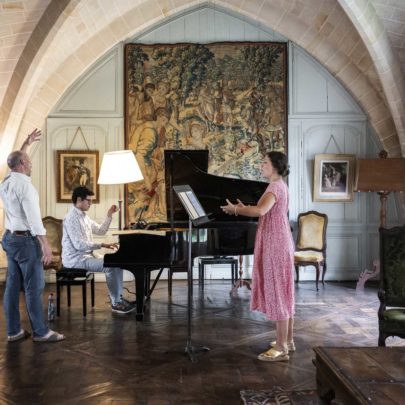
At Royaumont, this research unfolds in professional conditions, in contact with exceptional composers and performers. The unique aspect of Voix Nouvelles lies in the emphasis placed on dialogue: for several months, participants test their ideas against the experience of sound, exchange ideas with the performers, and benefit from in-depth guidance from the composers.
Designed as a laboratory, the Campus supports the entire creative process, from the initial idea to the finished work, which is rehearsed, transformed, created, and recorded. Here, one learns to compose by experiencing the music as it emerges. Rehearsals and discussions allow for the confrontation of written music with sound, the refinement of intentions, and the evolution of the score through experience.
Each edition opens up a territory for research without imposing a language or aesthetic. Voix Nouvelles fosters personal and collective research, tests intuitions and writing habits, and creates the conditions for a time of concentration, experimentation, and dialogue.
At Royaumont, composing therefore also means listening, experimenting, exchanging and developing one’s writing through contact with reality.
Following the training, the Royaumont Foundation continues to support the composers of Voix Nouvelles by awarding commissions for new works, which may be presented in the Royaumont Season or in the programming of partners, ensembles or professional soloists.
The 2027 edition > Composing the instrumental solo: sound, gesture, space, listening
This edition of Campus Voix Nouvelles is dedicated to instrumental solo, considered as a space for experimentation where sound, gesture, space and presence meet.
Mentored by composers Diana Soh and Mark Andre , the winning composers will be invited to develop a style of writing that is attentive to the materiality of the sound phenomenon, the theatricality of instrumental playing, and the very conditions of listening.
Each participant will develop an original work for a solo instrument, lasting approximately 10 minutes, in close dialogue with the performer associated with them.
The solo as a composition laboratory
More than an instrumental form, the solo constitutes a compositional laboratory. Each sound fully engages the performer’s body, the properties and possibilities of the instrument, the acoustics of the place, the surrounding silence, and the listener’s attention.
Writing is thus viewed as the organization of relationships between a sound material, a gesture, a space and a temporality.
The artistic approach is deliberately minimalist: the works will not employ electronics, amplification, video, or lighting design. This choice invites us to focus on the inherent resources of the instrument, the gesture, and the space. It also allows us to examine the conditions under which a work can circulate: how can we conceive of a piece that can be performed in different contexts without relying on external technical equipment?
This constraint does not exclude the gestural, spatial or scenic dimensions of the project. On the contrary, these can be fully integrated into the work, based on the performer’s own resources, the instrument and the venue: movements, postures, body or instrument orientation, relationship to the audience, movement in space, connection of several listening points, etc.
Five instruments, five research universes
Each composer will develop a work for a single instrument, in close dialogue with the performer associated with it.
During the application process, candidates indicate two instruments in order of preference from among the five offered. These two choices represent preferences and not two separate composition projects. The teaching team then determines the instrument assigned to each participant, based on their expressed preferences, the coherence of their projects, and the distribution of instruments among the five performers.
The composition project is then developed in dialogue with the associated performer, based on the technical, sonic and expressive possibilities of their instrument.
The five instruments offered are:
- Cavaillé-Coll organ — Lucile Dollat
- percussion — Yi-Ping Yang
- double bass — Florentin Ginot
- Sidey harpsichord — Ninon Hannecart-Ségal
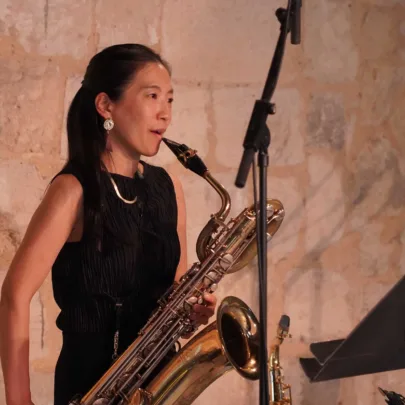
- saxophone — Marcus Weiss
Very different in their construction, their methods of sound production, their relationship to the body and their possibilities of projection in space, these instruments offer five areas of research.
Composers will thus be able to explore, depending on the instrument chosen, playing techniques, the materiality of sound, resonance regimes, instrumental gesture, breath, friction, attack, sound prolongation, the relationship between the body and the instrument, as well as the possibilities of staging and presence in space.
Listening to the sound material
Listening is the central theme of this edition. The works will be invited to explore micro-variations in timbre, transformations of sound material, the thresholds between sound, noise and silence, as well as the phenomena of resonance that make perception particularly active.
Silence is not presented as an absence, but as an essential component of the form, capable of preparing, prolonging, or transforming the sonic event. This focus on listening may also lead to questioning the conditions under which a sound appears, propagates, resonates, and disappears.
Gesture as musical material
Theatricality forms another line of research. It is not conceived as a spectacular addition, but as an inherent dimension of instrumental playing.
The performer’s body, movements, breath, gaze, relationship to the instrument, objects, space and audience can all become compositional parameters, according to very varied degrees of presence.
To work with the place
The Campus will be spread across the multiple spaces of Royaumont Abbey , whose architecture and gardens offer a remarkable diversity of resonances and listening situations.
Each space influences the projection of sound, its resonance, its decay, and the resulting perception. Composers will therefore be invited to consider the space as a true parameter of their composition.
A tour through the abbey
The public presentation of the ten works will take the form of a musical journey through different spaces of the Royaumont Abbey.
The composers will be involved in designing this program and invited to collectively reflect on the connections between their works. While the 10 pieces remain independent, their juxtaposition will be conceived as a whole: choice of venues, order of the pieces, transitions, audience movement, relationships between the works, and resonances between the spaces.
In detail: how does Voix Nouvelles work?
The Campus begins with a preparatory period via videoconference in January and February 2027. It continues until August with remote support, before concluding with an in-person creative residency at Royaumont, from August 17 to 28, 2027.
1. In January/February 2027: a preparatory period
An initial group session via videoconference allows participants to familiarize themselves with the theme of the edition and explore its various issues.
This preparatory period includes:
- a group session, presented by Michel Duchesneau and Caroline Traube, dedicated to the history and evolution of the relationship between composer and performer [1 hour];
- a group session, presented by Caroline Traube, dedicated to the acoustics and physicality of places, exploring the relationships between instrument, sound and space, as well as the tools and vocabulary to describe and verbalize the properties of an instrument and the sound phenomena associated with it [2 hours];
- a collective session of reflection and exchange via videoconference, led by Diana Soh and Mark Andre, on the challenges of composition for solo instrument and the relationships between sound, gesture, space and listening [2 hours];
- a group session, led by Diana Soh and Mark Andre, dedicated to preparing the relationship between composer and performer, particularly for young composers: how to prepare for a first session with a performer, how to clearly communicate one’s intentions and questions, how to arrive with ideas or concrete elements to test, how to experiment together, how to listen to feedback from the performer, and then how — or if it is relevant — to integrate them into one’s own composition process [1 hour];
- A session dedicated to each solo instrument, bringing together the two composers who compose for that instrument, and the performer of that instrument, Caroline Traube. The aim will be to present the instrument, its specific characteristics, its technical possibilities, and its different playing techniques [1 hour].
The specific details and dates of these meetings will be communicated to the selected individuals.
Participants in the Campus commit to attending the videoconferences, which are an essential part of the program. They will therefore ensure they are present at all scheduled sessions and fully participate.
In exceptional circumstances, the videoconferences will be recorded and their content will be available for later viewing. However, this delayed access cannot replace participation in live sessions, which fosters discussion, interaction, and the collective dynamic of the Campus.
This preparatory period provides a common foundation for reflection. It aims neither to impose a method of composition nor to define an aesthetic framework, but to give each individual the necessary tools to begin developing their project.
2. From February to summer 2027: writing in dialogue
From the preparatory phase onwards, each composer develops their project for the instrument assigned to them.
The writing process is accompanied by occasional exchanges with the performers and with Diana Soh and Mark Andre. These exchanges allow for testing ideas, clarifying instrumental possibilities, questioning writing choices and, when necessary, evolving the project.
Each composer benefits in particular from an individual meeting with each of the two supervising composers (Diana Soh and Mark Andre) around a first version of the score, corresponding to about 50% of its state of progress.
The assignments are submitted gradually to allow for regular support during the writing process.
The score is not considered a fixed object, but a space for research that is meant to evolve through dialogue with the performers and supervisors.
Sheet music submission schedule
- June 1, 2027: 50% of the work
- July 1, 2027: 80% of the work
- August 1, 2027: 100% of the work, accompanied by a presentation note of the work in French and English, of a maximum of 1000 characters, including spaces.
The final version is sent to the associated performer upon receipt so that they can familiarize themselves with the work and prepare the rehearsal work in advance of the residency.
3. At Royaumont: to deepen, transform, create
From August 17 to 28, 2027, the ten composers are gathered at Royaumont Abbey for an intensive period of work and immersion.
August 17-21, 2027: Composition work and artistic guidance
- Individual sessions with Diana Soh and Mark Andre to delve deeper into her score, clarify her intentions and consider the necessary transformations before rehearsals;
- Individual presentations of the composers: background, artistic approach, works;
- A session reflecting on the act of composing, by Diana Soh and Mark Andre;
- Individual writing sessions for his work;
- Group lecture by Diana Soh: how to prepare and conduct a work session, formulate your intentions and questions, experiment with the performer and integrate their feedback into the composition process;
- Collective lecture by Mark Andre: Music in a state / of disappearance;
- Creativity workshops “how to develop sources of inspiration”, led by Diana Soh and Mark Andre.
August 22: Rest day
August 23-27, 2027: Rehearsals with the performers
Each work is developed in close collaboration with its performer, in a continuous dialogue between the composer, the instrumentalist and the supervisors.
The score can thus be adjusted, sometimes profoundly transformed, based on what the experience of sound reveals.
Particular attention is paid to the presentation conditions of each work: choice of space, performer’s positioning, potential circulation, and relationship with the audience. This work also contributes to the design of the collective presentation process.
August 28, 2027: Public and recorded restitution
The ten works, each lasting approximately 10 minutes, are created as part of a musical journey through different spaces of Royaumont Abbey.
The performance is also recorded. The recordings are then uploaded to the Royaumont Foundation’s YouTube channel. The recording file is sent to each composer in the weeks following the Campus.
A Shared Campus
Voix Nouvelles takes place in parallel with the Campus Musiques transculturelles [ here ]. This proximity allows participants to share some time together and to broaden exchanges beyond their discipline and practice.
Joint sessions will bring together all participants to discuss various themes:
- physical practice sessions;
- workshops “The keys to the profession”;
- debates “The artist in society”;
- visit to the monument and the music library;
- A time for sharing and conviviality.
These shared moments fully participate in the spirit of the Campus: to make Royaumont a space where artistic practice, reflection and encounters with other artists mutually nourish each other.
Teachers
Composition
Diana Soh , composer (Singapore, 1984)
Mark Andre , composer (France, 1964)
Scientific support
Caroline Traube , professor at the Faculty of Music of the University of Montreal (musical acoustics, performance musicology)
Interpretation
Lucile Dollat , Cavaillé-Coll organ
Florentin Ginot , double bass
Ninon Hannecart-Ségal , harpsichord Sidey
Marcus Weiss , saxophone
Yi-Ping Yang , percussion
Occasional speakers
Michel Duchesneau , Professor at the Faculty of Music of the University of Montreal – Introductory Lecture
Denis Laborde , ethnologist, research director at the CNRS, director of studies at the EHESS, researcher at the Marc Bloch Centre in Berlin – Debates “The artist in society”
Jérémie Szpirglas , writer, editor, investigative journalist and lecturer – “Keys to the Profession” Workshops : Expressing your artistic identity and putting your music into words
A representative from Sacem (Society of Authors, Composers and Music Publishers) – “Keys to the Profession” Workshops : What is Sacem’s role with composers?
Currently recruiting – Body Practice Workshops
Learn more about…
Diana Soh
Diana Soh develops a body of work that explores the relationships between sound, gesture, space, body, and perception. Her practice is characterized by a particular attention to the interactivity of performance and to how close collaboration with performers can become a driving force for creation.
Her catalogue covers a wide range of ensembles, from solo and chamber music to orchestral works, as well as projects combining music, theatre, dance, film and visual arts. She also develops works conceived for specific venues and performance situations.
His work demonstrates a desire to “compose against habit”: to shift the conventional uses of instruments, to question listening behaviors and to create situations where the gesture of the performer and the perception of the public become an integral part of the work.
Mark Andre
Mark Andre is a French composer whose music pays particular attention to threshold phenomena: between sound and noise, appearance and disappearance, presence and silence, perception and listening.
Trained notably by Claude Ballif and Gérard Grisey at the Paris Conservatory, and later influenced by his work with Helmut Lachenmann in Stuttgart, he has been developing since the 1990s a body of work deeply centered on sonic material, micro-events, resonance phenomena, and the transformations of listening. His career also includes musicological research, particularly on the Ars subtilior.
In his works, sound is considered less as a stable material than as a fragile phenomenon, in permanent transformation, whose appearance, propagation, disappearance and traces become elements of the composition.
https://www.wisemusicclassical.com/composer/5626/Mark-Andre/
https://soundcloud.com/mark-andre
Lucile Dollat
Lucile Dollat is a French organist and improviser. After studying at the Saint-Maur-des-Fossés Conservatory with Éric Lebrun and Pierre Pincemaille, she entered the Paris Conservatory (Conservatoire national supérieur de musique et de danse de Paris), where she trained with Olivier Latry, Michel Bouvard, Thierry Escaich, László Fassang, Fabien Waksman, and Jean-Baptiste Courtois. She earned a Master’s degree in organ performance in 2020, followed in 2021 by a Bachelor’s degree in organ improvisation and a Master’s degree in composition, both graduating with highest honors.
Winner of several international competitions, including the Grand Prize and the Audience Prize at the André-Marchal – Gaston-Litaize Competition in 2017, Lucile Dollat enjoys a concert career in France and abroad. She performs both as a soloist and with major ensembles, notably the Ensemble Intercontemporain and the Radio France orchestras. An artist-in-residence at Radio France and the Royaumont Foundation, she champions a repertoire ranging from early music to contemporary works. She is also a professor of keyboard harmony at the Paris Conservatory (CNSMD) and co-titular organist of the Cavaillé-Coll organ at Saint-Maurice de Bécon.
Florentin Ginot
Florentin Ginot is a double bassist, soloist, and member of the Ensemble Musikfabrik since 2015. His work is particularly marked by contemporary creation and in-depth collaboration with composers, which has led him to contribute to the development of a new repertoire for the double bass. He collaborates notably with Georges Aperghis, György Kurtág, Rebecca Saunders, and Helmut Lachenmann.
He also dedicates himself to the solo repertoire and the invention of new stage forms. Curious about the intersections between disciplines, he founded the HowNow company in 2017, where he serves as artistic director. HowNow develops stage performances combining original music, dance, theatre, and contemporary circus. This approach extends his interest in the relationship between the body, the instrument, space, and the stage.
His work as a soloist thus demonstrates a desire to open up the boundaries of the double bass, both through the exploration of its repertoire and sonic possibilities and through dialogue with other artistic disciplines.
Ninon Hannecart-Ségal
Ninon Hannecart-Ségal is a pianist and harpsichordist. Classical revelation of the Adami in 2021 and artist in residence at the Royaumont Foundation, she develops a keyboard practice particularly open to repertoires, instruments and concert formats.
His work combines early music, contemporary creation, improvisation and chamber music. His interest in the modern harpsichord, particularly the Sidey harpsichord from Royaumont, leads him to question the possibilities of this instrument beyond the historical repertoire and to explore its timbral and expressive resources in contemporary contexts.
She regularly collaborates with ensembles and artists of different generations and also develops concert formats that involve several instruments and different ways of listening to and perceiving the keyboard.
Marcus Weiss
Marcus Weiss is one of the leading figures in contemporary saxophone music. For several decades, he has actively contributed to making the saxophone an instrument of creation and research, developing a vast repertoire of solo pieces and chamber music.
Many major composers have written for him, including Georges Aperghis, John Cage, Helmut Lachenmann, Rebecca Saunders, Salvatore Sciarrino, Toshio Hosokawa, and Karlheinz Stockhausen. His work as a soloist, chamber musician, and teacher is closely linked to this relationship with composers and the creation of new works.
His work is distinguished by a thorough exploration of the technical, acoustic, and expressive possibilities of the saxophone and by a constant commitment to the transmission and expansion of its repertoire. He is notably a professor at the Basel Academy of Music and co-author of *The Techniques of Saxophone Playing* , a seminal work on contemporary techniques for the instrument.
Yi-Ping Yang
Yi-Ping Yang is a percussionist, timpanist and creative artist. Trained at the conservatories of Boulogne-Billancourt and Lyon, Geneva and Munich, she has pursued a career since 2000 between orchestra, creation and teaching.
A member of the Percussions de Strasbourg and a collaborator with GRAME, she participates in numerous contemporary creations with the Ensemble Orchestral Contemporain. Her artistic approach uses percussion as a meeting point between musical composition, performing arts, and cultures. She explores the possibilities of gesture, timbre, and space, and develops projects at the intersection of music and theater, as a composer, musician, and actress.
Winner of several international competitions, notably in Luxembourg, Lyon, and Eindhoven, she performs in France and abroad. Artistic director of the International Timpani Festival (RIT-Infinity) and co-artistic director of Eklekto Geneva Percussion Center, she is dedicated to promoting percussion. An associate professor at the Lyon Regional Conservatory (CRR) since 2012, she also teaches at the Lyon National Conservatory of Music and Dance (CNSMD) and the Shanghai Conservatory. In 2024, she received the “Fabulous Signature” award from the Signature Foundation.
Michel Duchesneau
Michel Duchesneau is a musicologist and full professor at the Faculty of Music of the University of Montreal, where he has taught since 2002. Holder of the University of Montreal Chair in Musicology, he has directed the Interdisciplinary Observatory for Creation and Research in Music (OICRM) since 2004. His research focuses on French music of the first half of the 20th century, the sociology of music audiences, contemporary musical creation and its dissemination mechanisms, as well as the mediation and management of musical institutions. He is the author of *L’Avant-garde musicale en France et ses sociétés de 1871 à 1939* and the co-editor of several works devoted to musical modernity and the composer Charles Koechlin. He also edited the journal *Circuit, musiques contemporaines* and served as executive director of the Société de musique contemporaine du Québec. In 2012, he received the Royal Musical Association’s Dent Medal for his outstanding contribution to musicology.
Denis Laborde
Denis Laborde is an anthropologist and musician. After studying at the Paris Conservatory, he taught at conservatories and worked at Radio France, where he notably conducted the world premiere of Alvin Curran’s Crystal Psalms . He then turned to anthropology and in 1993 defended his doctoral thesis at the EHESS (School for Advanced Studies in the Social Sciences) on the poetic and musical improvisations of bertsulari, the Basque improvisers. Joining the CNRS (French National Centre for Scientific Research) in 1997, he became a research director and developed an original approach to music as a tool for analyzing human societies. His research focuses on improvisation, contemporary musical creation, world music, festivals, and musical practices in the context of migration. As a director of studies at the EHESS, he founded the ARI-CNRS Institute in Bayonne, dedicated to the anthropology of music. In 2020, he received the CNRS Silver Medal for his body of work.
Caroline Traube
Caroline Traube is an interdisciplinary researcher who has been working on human and musical migration for over twelve years. Her research interests include the career paths and professionalization challenges faced by immigrant musicians, the role of music in the migration experience, and the work of performing arts presenters (festivals and venues) in multicultural contexts. She directs the collaborative action-research project Musique Immigration ( musique-immigration.ca ) and is co-editor of the forthcoming collective work , Participation culturelle, arts et immigration (Cultural Participation, Arts and Immigration ), published in the “Monde culturel” series by Presses de l’Université Laval. She also produces the podcast Le monde dans mes oreilles (The World in My Ears) , which explores the stories of immigrants through the lens of the music that has shaped their journeys. The second season of this podcast is entirely co-developed and co-presented with the Rencontres internationales du documentaire (International Documentary Film Festival).
Alongside her research, Caroline has worked in the music industry as coordinator of the Constantinople ensemble and in charge of outreach at the Centre des musiciens du monde in Montreal (2017-2020). She also served on the Board of Directors of the Conseil des arts de Montréal as Chair of the Music Sector (2022-2025).
Jérémie Szpirglas
Jérémie Szpirglas, after a career spanning science, music, and ocean sailing, now devotes himself to writing. Author of fiction ( Pater Dolorosa , Le Passeur Éditeur, 2019; Anthropocène , Publie.net, 2022), and former cultural journalist (Le Monde de la Musique, Mouvement, editor-in-chief of Musique(s) magazine), he also lends his writing talents to various figures in the artistic and political spheres. He writes numerous reference texts for major French cultural institutions (Philharmonie de Paris, Ircam, Festival d’Automne, Ensemble intercontemporain, Théâtre des Bouffes du Nord, Opéra de Paris, Opéra-Comique, etc.). He is also the author of several books on the work of Serge Gainsbourg, notably co-authoring the definitive work: Le Gainsbook , Seghers, 2019.
Accommodation conditions
During their residency at Royaumont, the winners benefit from:
- accommodation at Royaumont Abbey in a single room with private bathroom;
- meals prepared and served by the Abbey’s catering team;
- of group shuttles between Viarmes station and the Abbey on arrival on August 16, 2027, and on departure on August 29, 2027.
Previous editions – Restitutions
From 202 to 2025…
![[Concert] Académie Voix Nouvelles au Festival de Royaumont - Première partie](https://i.ytimg.com/vi/aMA8e7UbhTo/hqdefault.jpg)
![[Concert] Académie Voix Nouvelles - "Op Op CCC Variations" de Théo Mérigeau](https://i.ytimg.com/vi/rfRC8eJVz68/hqdefault.jpg)
![[Concert] Académie Voix Nouvelles - "Sans raisons apparentes" de Maxime Mantovani par Court-circuit](https://i.ytimg.com/vi/Gv3CtZkT7t0/hqdefault.jpg)


The winners talk about it
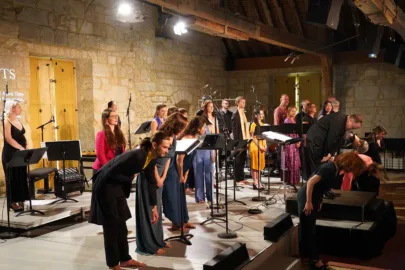
“An intense, enriching, and stimulating training program.”
“A very enriching training program, thanks to the interaction with other training programs, and the quality of the supervision and the pace of work.”
“A decisive step in the evolution of my compositional style and my career.”
Course details
From August 17 to 28, 2027
Audience
10 female and male composers
Prerequisites and conditions for accessing the training
To be in the final year of higher education, or to have professional or pre-professional experience.
Fluency in spoken English is required, as it is the main language of instruction and communication within the Campus. Proficiency in French is an asset.
Participants formally commit to attending the entire training course.
Duration
At Royaumont
Arrival: August 16, 2027, late afternoon
Training: from August 17 to 28, 2027 inclusive
Departure: August 29, 2027 in the morning
Number of days: 11 days of training and 1 day of rest
Number of hours: 77 hours of training
Rates
See the pricing conditions page.
€2000 including VAT (€400 including VAT registration fee + €1600 including VAT participation fee for organization costs)
Application
Selection is based on application by the supervisors and the academic manager.
Information to be provided:
- Biography in French and English.
- CV presenting educational background, artistic experiences and main achievements.
- Lettre de motivation présentant :
- the reasons motivating the desire to participate in the Campus Voix Nouvelles;
- the skills, experience and qualities that the candidate wishes to mobilize in this context;
- the first research avenues that the candidate wishes to explore in connection with the theme of the edition: sound question, formal intuition, relationship between gesture and sound, hypothesis around a mode of playing, reflection on space or listening conditions, etc.
There is no requirement to submit a completed composition project or a preliminary score for one of the proposed instruments.
The work developed during the Campus will last approximately 10 minutes.
Candidates also indicate two instruments in order of preference from among the five instruments offered.
These two choices represent preferences and not two separate compositional projects. The final instrument will be determined in consultation with the selected individual at the end of the preparatory phase, before the writing process begins.
Applications that do not mention both instrument choices will not be considered.
- Three scores and the three corresponding recordings.
Candidates must provide three representative works of their artistic approach, accompanied by their scores and corresponding recordings.
The recordings must allow the jury to appreciate the sound quality and interpretation of the works presented.
The works may have already been created or may still be unpublished.
- A recent, royalty-free photograph, with credit given .
Instruments offered:
- Sidey harpsichord
- Cavaillé-Coll organ
- bass
- saxophone
- percussion (the list will be defined in dialogue between the composer and the performer)
Calendar
Closing date for applications :
November 8, 2026 at midnight
Selection announcement:
week of January 4, 2027
All Royaumont Foundation training programs have a minimum lead time of 11 working days.
Example: if the Royaumont Foundation validates the registration request on June 14, it can offer the beneficiary a course starting on June 29.
Fiche programme
Version #1 of 12/08/2026
Validity period of version no. 1: 1 year, renewable
Course description/content of the training
| Date | Contents | Who ? |
| January/February (dates to be confirmed) | Via videoconference • A group session, presented by Michel Duchesneau and Caroline Traube, dedicated to the history and evolution of the relationship between composer and performer [1 hour]; • A collective reflection and exchange session via videoconference, led by Diana Soh and Mark Andre, focusing on the challenges of composition for solo instrument and the relationships between sound, gesture, space and listening [2 hours]; • A group session, led by Diana Soh and Mark Andre, dedicated to preparing the relationship between composer and performer, particularly for young composers: how to prepare for a first session with a performer, clearly communicate one’s intentions and questions, arrive with ideas or concrete elements to test, experiment together, listen to the performer’s feedback, and then decide how — or if it is relevant — to integrate them into one’s own composition process [1 hour]; • A session dedicated to each solo instrument, bringing together the two composers who compose for that instrument, and the performer of that instrument, Caroline Traube. The aim will be to present the instrument, its specific characteristics, its technical possibilities, and its different playing techniques [1 hour]. | Beneficiaries Supervisors Scientific support |
| From February to summer 2027 | Via videoconference – By email From the preparatory phase onwards, each composer develops their project for the instrument assigned to them. The writing process is accompanied by occasional exchanges with the performers and with Diana Soh and Mark Andre. These exchanges allow for testing ideas, clarifying instrumental possibilities, questioning writing choices and, when necessary, evolving the project. Each composer benefits in particular from an individual meeting with each of the two supervising composers (Diana Soh and Mark Andre) around a first version of the score, corresponding to about 60% of its state of progress. The assignments are submitted gradually to allow for regular support during the writing process. | Beneficiaries Supervisors / Speakers |
| August 17-21, 2027 | At Royaumont • Welcoming beneficiaries and supervisors. • Campus presentation: educational objectives, schedule. • Individual sessions with Diana Soh and Mark Andre to delve deeper into her score, clarify her intentions and consider the necessary transformations before rehearsals; • Individual presentations of the composers: background, artistic approach, works; • Reflection session on the act of composing, by Diana Soh and Mark Andre; • Individual writing sessions for his work; • Group lecture by Diana Soh: how to prepare and conduct a work session, formulate your intentions and questions, experiment with the performer and integrate their feedback into the composition process; • Collective lecture by Mark Andre: Music in a state / of disappearance; • Creativity workshops “how to develop sources of inspiration”, led by Diana Soh and Mark Andre; • Physical practice sessions; • Debates: The artist in society; • Workshop: The keys to the profession. | Beneficiaries Supervisors Head of Education Scientific support |
| August 22 | Day of rest. | |
| August 23-27, 2027 | At Royaumont • Repetitions; • Physical practice sessions; • Workshop: The keys to the profession. | Beneficiaries Supervisors / Speakers Interpreters Scientific support |
| August 28, 2027 | At Royaumont • Recorded public presentation. | Beneficiaries Supervisors / Speakers Interpreters Scientific support |
This schedule can be adapted according to educational and artistic needs.
Number of traines minimum / maximum
Minimum number of artists: 10
Maximum number of artists: 10
Educational objectives
Knowledge
- Identify the technical, sonic and expressive possibilities of the proposed solo instruments.
- Understanding the relationships between sound, instrumental gesture, body, space, silence and listening in the composition process.
- Understanding the influence of the acoustic characteristics of a place on the projection, resonance and perception of sound.
- Identify the sonic and expressive resources of solo instruments and the possibilities offered by their different modes of playing.
Expertise
- To experiment with the sonic, technical and gestural possibilities of a solo instrument and integrate them into a personal compositional approach.
- To design and develop a work for solo instrument taking into account the specificities of the instrument, the possibilities of the performer and the characteristics of the venue.
- To test one’s compositional choices through contact with sound and interpretation, and to develop one’s score based on the experience of repetition.
- To integrate, where relevant, the bodily, gestural and scenic dimensions of instrumental playing into the musical project.
- Consider listening conditions, resonance, silence and space in the design and creation of the work.
- Organize your composition work and respect the deadlines set for the different stages of creating the work.
- Ensure the quality of the delivered score: format, legibility, clarity of the instructions, language used, adherence to the required information.
- To present orally one’s artistic identity, approach and the intentions behind one’s composition project.
- To finalize a work for solo instrument and present it in a public and recorded performance.
- To leverage exchanges and shared experiences with other artists to enrich one’s thinking and creative process.
- Develop the ability to situate one’s artistic practice within one’s professional and societal environment.
soft skills
- Develop an attitude of listening, observation and questioning in one’s creative process.
- Listening to the performer and establishing a constructive dialogue around the possibilities of the instrument and the realization of the work.
- Being able to adapt one’s writing choices based on exchanges with interpreters and supervisors.
- To actively participate in a collective research process, while respecting the uniqueness of each individual’s artistic approach.
- To exchange ideas with artists with different practices, backgrounds and aesthetics, in an approach of listening and openness.
- To take part in a collective reflection on the place of the artist in society and on the challenges of professional artistic practice.
Skills targeted
At the end of the training the beneficiary will be able to :
- identify and exploit the sound and technical resources of a solo instrument;
- experiment and select different playing modes based on a compositional intention;
- to integrate gestural, bodily and spatial dimensions into musical writing when relevant;
- to take into account the acoustic characteristics of a place in the design and creation of a work;
- to collaborate with a performer by formulating one’s artistic intentions, taking into account their feedback and adapting one’s writing;
- to confront one’s score with the experience of sound and interpretation and to evolve it accordingly;
- organize your composition work and respect the deadlines set for the different stages of completion;
- finalize a score that is readable and usable by the performer;
- to present orally their artistic approach and compositional choices;
- designing the conditions for presenting a work in a collective musical journey;
- finalize and present a work for solo instrument of approximately 10 minutes as part of a public and recorded performance;
- enrich one’s artistic approach through exchange with artists with different practices, backgrounds and aesthetics;
- to situate one’s practice as a composer within one’s professional, artistic and societal environment.
Methods used
Teaching aids :
The Campus is based on a pedagogy founded on experimentation, individualized and collective support, dialogue between composition and interpretation, and testing works in professional conditions.
- Remote group preparatory sessions, including lectures, presentations and discussions about composition for solo instrument, the instruments offered, acoustics, and listening.
- Individualized and collective artistic guidance by the supervising composers, allowing the project to be developed, the writing choices to be questioned and the score to evolve.
- Individual time for composition and research, accompanied by a progressive submission of work and feedback on the different stages of writing.
- Meetings and workshops with the performers, dedicated to discovering the instruments, the technical possibilities and the playing methods, then to testing the works.
- Rehearsals in the form of workshops, allowing the score to be compared with sound and interpretation and to evolve from experience.
- Individual presentations, peer exchanges and collective reflection time, focusing on artistic approaches, the act of composing and the challenges of contemporary creation.
- Shared time with the Transcultural Music Campus, including physical practice, professional workshops, debates on the place of the artist in society, visit to the monument and the music library and time for exchange.
- Professional situation and public presentation, with collective design of the route through the Abbey and presentation of the finalized works in the context of a recorded presentation.
Educational and artistic exchanges are conducted in French or English, depending on the level of understanding of the participants.
Technical means:
- Workrooms equipped with tables, desks and chairs.
- Individual rooms, equipped with a table, allowing composers to work.
- Documentation and work resources accessible via a private Google Drive.
- Access to a photocopier and binding machine, and provision of the necessary materials for printing sheet music, including paper, binding materials, and covers. The binding machine can bind A3 sheet music in landscape orientation only.
Monitoring and evaluation methods
The evaluation is based on the practical work carried out throughout the training, the exchanges with the supervisors and interpreters, as well as on the final work presented at the end of the Campus.
The evaluation takes into account:
• the progress of the beneficiary;
• its ability to mobilize the contributions of the training;
• his ability to develop his project based on feedback from supervisors and interpreters;
• the quality of the work done;
• his involvement in the different stages of individual and collective work;
• its ability to meet the defined deadlines.
An individual interview with the educational manager allows for a review of the progress made, the skills acquired during the training and, when relevant, for discussion of the beneficiary’s career prospects and orientation.
An assessment grid of acquired skills, completed by the supervisors and accompanied by their comments, is given to the beneficiary at the end of the training.
The beneficiaries sign a sign-in sheet for each half-day.
At the end of training
A certificate of completion stating the objectives, nature and duration of the training and the results of the skills assessment is given to the beneficiary as well as the certificate where applicable.
Qualitative assessment methods
On the last day of the training, the beneficiary completes a qualitative evaluation form relating to their training experience and allowing for the evaluation of its artistic, pedagogical, human and material dimensions.
During the course, face-to-face
- Evaluation through practical work of the beneficiary, of their responsiveness and their ability to quickly integrate the proposals made by the speakers; as well as their capacity to integrate into the group.
The beneficiaries sign a sign-in sheet for each half-day.
Accessibility and consideration of disability situations
The Foundation’s training courses are open to people with disabilities. Adaptations to the training and participation conditions can be considered depending on the needs and specificities of each situation and each course.
In order to discuss specific needs and anticipate any necessary adjustments, those concerned are invited to contact the Foundation when applying.
Contact
Educational and administrative contact person
Samuel Agard, artistic advisor and administrator of the Music Creation Hub
s.agard@royaumont.com
Logistics contact person
Currently recruiting for a production manager position.
Disability referents
Samuel Agard and Doriane Trouboul
referenthandicap@royaumont.com
VHSS Referent
Mélanie Thyss, Human Resources Manager
vhss@royaumont.com
With the collaboration of the Interuniversity Research and Creation Group – Music and Societies, Faculty of Music, University of Montreal.
The Société Générale corporate foundation is a key sponsor of the Royaumont Foundation’s musical programs.
As a long-standing partner of Royaumont, SACEM supports the Foundation’s Musical Creation Hub.
With the support of the Henry Goüin Committee.
With the support of the Friends of Royaumont Association.