Period
From July 12 to 30, 2027
Presentation
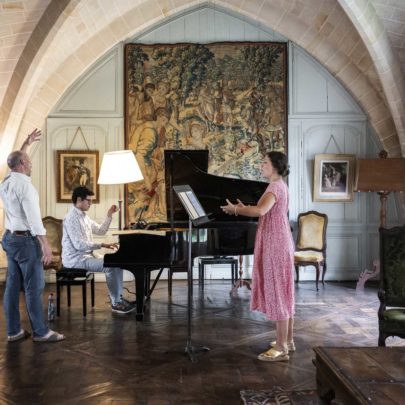
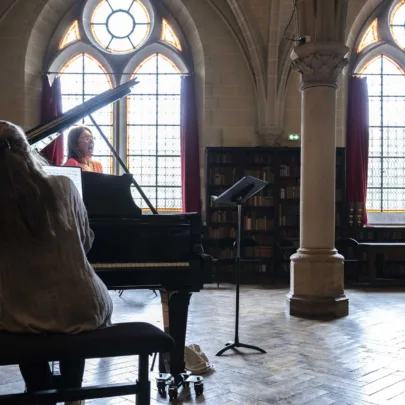
At the crossroads of poetry and music, the genre of the melody and the lied is one of the richest, most intimate, but also one of the most demanding, requiring a very special alchemy between a singer and a pianist.
The new Melody-Lied Campus allows the winners to complete, over 3 weeks, work that is linguistic, literary and musical, and to explore this extremely vast repertoire.
For this first three-week edition, each week will be led by a duo of different masters , chosen from among the greatest recitalists on the international scene: Natalie Dessay and Philippe Cassard , Christoph Prégardien and Ulrich Eisenlohr , Camilla Tilling and Susan Manoff .
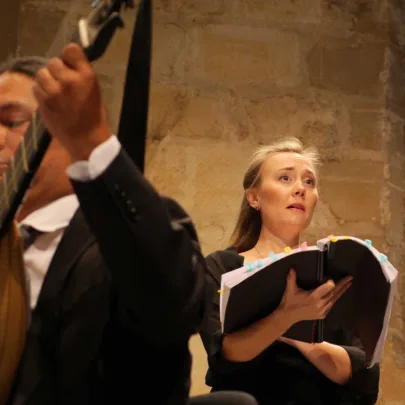
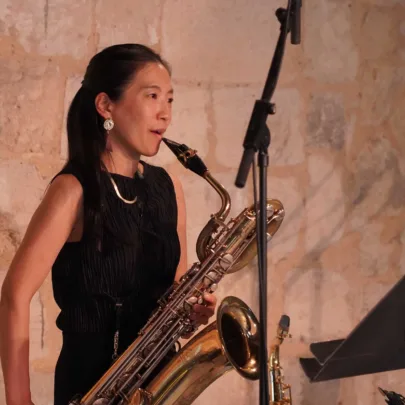
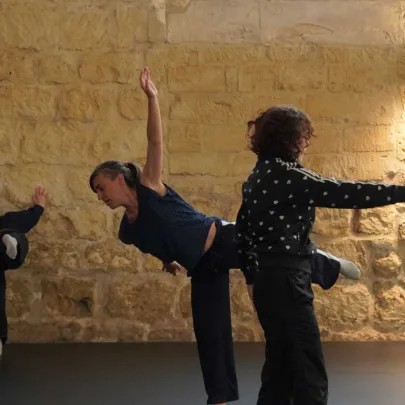
The training of the laureates is enriched by introductory courses in art history, allowing them to establish connections between the museum’s collections and the musical repertoire. Shared activities will also be organized with the other trainees at the abbey: improvisation sessions combining music and dance, discussions, and reflections on the humanities. For the young laureates, the Academy provides a professional integration program that will allow them to gain exposure to the public and programmers through a series of concerts, presentations, and masterclasses given at Royaumont and elsewhere.
Teachers
Duo 1> Natalie Dessay and Philippe Cassard : 5 days from July 13th to 17th
Duo 2> Christoph Prégardien and Ulrich Eisenlohr : 5 days from July 20 to 24
Duo 3> Camilla Tilling and Susan Manoff : 5 days from July 26 to 30
Internationally renowned, Natalie Dessay (without the “h,” a subtle homage to Natalie Wood) began her career in the coloratura soprano repertoire. (Queen of the Night, Lakmé, Zerbinetta, Olympia…)
Over the years, the artist has expanded his repertoire to include bel canto heroines, while continuing to champion the French repertoire.
With Philippe Cassard, her recital pianist, she has given around sixty concerts since 2012 on the most prestigious stages: Carnegie Hall in New York, Jordan Hall in Boston, Barbican in London, Théâtre des Champs Elysées in Paris,… This collaboration has resulted in the release of three CDs: “Debussy” (Erato), “Fiançailles pour rire” (Erato) and “Schubert” (Sony).
Considered by his peers, critics, and the public as one of the most engaging and accomplished musicians of his generation, Philippe Cassard was trained by Dominique Merlet and Geneviève Joy-Dutilleux at the Conservatoire National Supérieur de Musique de Paris. He graduated there in 1982 with First Prizes in Piano and Chamber Music.
He furthered his studies for two years at the Vienna University of Music and subsequently received guidance from the legendary Nikita Magaloff. A finalist in the Clara Haskil Competition in 1985, he won First Prize at the Dublin International Piano Competition in 1988.
“His lyric tenor voice had a youthful glow, yet he sang with plaintive beauty and piercing insight.” The New York Times
Precise vocal control, clear diction, intelligent musicality, and an ability to reach the heart of everything he sings secure Christoph Prégardien a place among the world’s greatest lyric tenors. Particularly noted as a Lieder interpreter, he also performs regularly with renowned orchestras around the globe.
He has collaborated with the Berlin and Vienna Philharmonic Orchestras, the Concertgebouw Orchestra of Amsterdam, the Philharmonia Orchestra, the Orchestre Philharmonique de Radio France, as well as with the Boston and San Francisco Symphony Orchestras, alongside conductors such as Barenboim, Metzmacher and Thielemann.
His extensive repertoire includes major Baroque, Classical, and Romantic oratorios and passions, as well as works from the 17th and 20th centuries. In opera, he has notably performed the roles of Tamino ( The Magic Flute ), Almaviva ( The Barber of Seville ), and Fenton ( Falstaff ). Teaching remains an important part of Christoph Prégardien’s musical life. After many years at the Zurich University of the Arts and a professorship at the Cologne Academy of Music, he continues to give masterclasses to young singers around the world. He has taught at several training sessions for piano/voice duos at the Royaumont Foundation (formerly the Orsay-Royaumont Academy) since 2016.
Pianist Ulrich Eisenlohr specializes in lieder accompaniment and chamber music. He has collaborated with many renowned German singers, conducted a complete cycle of Schubert lieder, and taught for many decades.
Eisenlohr was born in 1950. He studied piano at the Mannheim University of Music and Performing Arts, where his teacher was Rolf Hartmann, and pursued specialized studies in lieder with Konrad Richter at the Stuttgart University of Music and Performing Arts. From the beginning of his career, Eisenlohr was primarily active as a vocal accompanist and chamber musician. His collaborators in the field of lieder include Christoph Prégardien, Matthias Goerne, Wolfgang Holzmair, and a long list of other German singers.
Camilla Tilling, one of Sweden’s most accomplished singers, has won the admiration of conductors, audiences and critics alike for her radiant soprano voice and outstanding artistry, during a long international career that has taken her to the world’s greatest opera, concert and recital stages.
An accomplished recitalist, Tilling has recorded numerous collections of Lieder by composers such as Strauss, Schumann, Schubert, and Grieg. She has toured extensively with her acclaimed “Swedish Nightingale” program, entitled “Jenny Lind: Love and Lieder,” including North America alongside the renowned pianist Emanuel Ax, and has performed regularly at the Bergen International Festival, the Oxford Lieder Festival, and Wigmore Hall in London. Her impressive discography also includes orchestral works by Haydn with Bernard Haitink, Handel and Purcell with Emmanuelle Haïm, Grieg with Paavo Järvi, Brahms with Marek Janowski, Cherubini with Riccardo Muti, as well as a critically acclaimed solo collection of arias by Mozart and Gluck.
After studying piano and chamber music at the Manhattan School of Music and the University of Oregon, Susan Manoff continued her studies with Gwendoline Kozlowski, deepening her knowledge of the Lied and mélodie repertoire. She won the Lilian and Paul Petri Competition for Advanced Study as both a soloist and accompanist, then moved to France where she worked with Gaby Casadesus and Noël Lee. A recipient of the Royaumont Foundation grant, she studied Lied and mélodie with the renowned vocal coach Ruben Lifschitz. In 1985, she was appointed role coach at the Paris Opera’s School of Lyric Art, accompanying all of Hans Potter’s and Christa Ludwig’s classes. Her work subsequently took her to the Munich Opera, the Capitole de Toulouse, and the Guildhall Opera House in London.
Passionate about chamber music, Susan Manoff regularly performs at festivals and in major concert halls such as the Théâtre des Champs-Élysées, the Salle Gaveau, Wigmore Hall, Carnegie Hall, and the Konzerthaus Wien, alongside opera singers such as Véronique Gens, Patricia Petibon, Vincent LeTexier, Natalie Dessay, Hélène Delavault, and Christa Ludwig. A lover of theatre, she has also created numerous shows blending music and text, in which her partners have included Jean Rochefort, Fabrice Luchini, and Marie-Christine Barrault.
Accommodation conditions
During their training at Royaumont, the successful candidates benefit from:
- Accommodation at Royaumont Abbey in a single room with private bathroom;
- Meals prepared and served by the abbey’s catering team;
- Group shuttles will run between Viarmes train station and the abbey upon arrival, on rest days, and upon departure. (Timetable to be determined by the Royaumont team)
Words from the previous students
“An unforgettable and formative experience”
“A turning point, a pivotal moment that made me understand essential things both in my relationship with the instrument and in my connection with my duo partner.”
“Inspiring and life changing as an artist”


Terms and conditions
Audience
- 5 piano/vocal duos
Prerequisites and conditions of access to training
- To be a professional singer upon completion of higher education.
- Participants formally commit to attending the entire training course.
- The conditions of access are transmitted during the training.
Calendar
- Monday, July 12: Afternoon at the La Grange-Fleuret Music Library (Paris)
- From Tuesday 13th to Saturday 17th July: Group and individual lessons
- Sunday, July 18: Rest day
- Monday, July 19: Afternoon at the Musée d’Orsay
- From Tuesday 20th to Saturday 24th July: Group and individual lessons
- Sunday, July 25: Rest day
- From Monday, July 26th to Friday, July 30th: Group and individual lessons
- Departures on the evening of July 30th or the morning of July 31st
Total: 19 days (including 2 days of rest), or 119 hours
Public presentation
In full view: July 17, July 24 and July 30, 2027
Several public presentations will take place during the Royaumont campus or off-campus. These presentations are unpaid.
Rates
€2,800 including VAT (registration fees = €400 including VAT + participation fee of €2,400)
Application
Pre-selection based on application followed by an interview
The musicians in each duo must submit an individual application. The cover letter, biography, and photo can be the same for both members of the duo.
Selection based on application by the teaching team
- Cover letter
- Short biography (600 characters including spaces)
- CV
- Photo (max: 100MB)
- 1 or more video files related to the chosen course (please note that WeTransfer links will not be uploaded)
To be presented for the audition:
- 1 Lied and 1 Melody
Calendar
Submission of applications
Application deadline: November 1, 2026 (midnight)
- Step 1: Pre-selection based on application
- Step 2: Shortlisted candidates will be invited for an audition (schedule below)
- Final answer: from March 2027
Auditions
- Wednesday, January 20, 2027 (and/or Friday, January 22, subject to change): Paris (8th arrondissement) at the La Grange-Fleuret music library
- First half of February 2027: London (UK) (one day to be confirmed)
- First half of February 2027: Berlin (Germany) (one day to be confirmed)
All Royaumont Foundation training programs have a minimum lead time of 11 working days.
Example: if the Royaumont Foundation validates the registration request on June 14, it can offer the beneficiary a course starting on June 29.
Fiche programme
Version #1 of September 21, 2026
Validity period of version no. 1: 1 year, renewable
Course description/content of the training
| Day 1 | Afternoon: Welcoming beneficiaries at the La Grange-Fleuret Music Library (Paris). Presentation of the campus, the Foundation and the library collections. | In-person welcome, with all training participants. A group meeting with the beneficiaries and the Royaumont teams. |
| Weeks 1, 2 and 3 | Day of classes at Royaumont Morning: lessons in pairs and/or groups, detailed work on each piece, definition of aesthetic and technical specificities Afternoon: lessons in pairs and/or groups, detailed work on each piece, definition of aesthetic and technical specificities End of day : Shared activities with other campuses | Sessions led by the speakers |
Number of traines minimum / maximum
Floor staff: 4 piano & vocal duos
Maximum number of members: 5 piano & vocal duos
Prerequisites and conditions of access to training
To be a young professional singer and/or instrumentalist at the end of higher education, forming a duo.
Participants formally commit to attending the entire campus program.
The conditions of access are communicated during the training.
Educational objectives
Knowledge
- Understanding a sung and spoken text in its literal meaning as well as its subtext
- To integrate the pronunciation of sung and spoken texts in one’s native language as well as in foreign languages
Expertise
- Acquire the technical tools needed to interpret a repertoire, and know when and how to use them.
- Working and searching in a music library: finding a specific work or searching for lesser-known works to perform, identifying an edition and its relevance to a composer’s oeuvre.
- To take into account the information provided by an art historian in order to refine one’s interpretation of a work
- Defining one’s own interpretation of a work based on the advice provided by the supervisors
soft skills
- To hear and understand the requests of the supervisors and their musical suggestions
- To clearly express one’s musical and stage intentions and be able to justify them
- Sharing their interpretation with an audience during the final performance
- Adapting to the requirements of a repertoire (pronunciation, musicality of a language, theatrical performance…)
Skills targeted
At the end of the training the beneficiary will be able to :
- Learn the specific repertoire of French art songs and German Lieder
- To delve deeper into German and French prosody…
- Analyzing poetic texts
- Develop a concert program
Methods used
Teaching aids :
Practical, face-to-face instruction in the form of interpretation courses given by instructors in small groups or collectively depending on the repertoire covered.
The courses are taught in English or French.
One or more public presentations will take place during the Royaumont campus or off-campus. They bring together all the beneficiaries and are unpaid.
Technical resources available :
The rooms are spacious, equipped with music stands (fixed or folding), chairs or stools suitable for musicians (without armrests), and the instruments required for the lessons. Participants must bring their own instruments and sheet music, which are not provided. Outside of class time, rehearsal spaces can be made available free of charge, upon request and subject to the availability of rooms and instruments.
The abbey monument in its entirety (rooms and gardens)
Documentation via private drive.
Monitoring and evaluation methods
Before the training
Pre-selection based on application file (via the platform…) by the academic director, through a questionnaire which helps to identify the needs of the beneficiary.
Professional level assessment through biography, copies of awards and diplomas, and audio and/or video files.
During the course, face-to-face
- Evaluation of the beneficiary’s responsiveness and ability to quickly integrate the suggestions made by the consultant.
- During the presentation at the end of the training: the interpretation of one or more works in a real situation in front of an audience allows us to appreciate the evolution of the interpretation, as well as the emotional and physical postures.
The beneficiaries sign a sign-in sheet for each half-day.
At the end of training
A certificate stating the objectives, nature and duration of the course, and the results of the training assessment, is given to the beneficiary, along with the certificate where applicable.
Qualitative assessment methods
The beneficiary completes a qualitative evaluation form in order to assess the achievements of the training from an artistic, pedagogical, human and material point of view.
Concerts outside the training framework allow us to follow the evolution of the beneficiary’s career after the training, and in particular to assess the quality of the performance as well as the number of concerts given.
Accessibility and consideration of disability situations
The Royaumont Foundation has made the acceptance and participation of people with disabilities a strong commitment to its project. Our training courses are open to people with disabilities and different arrangements can be made according to the specificities of each course. To discuss your needs, please contact us when you register, or get in touch with our disability advisors.
Contact
Pedagogical manager
NN, artistic director of the Voice and Repertoire department
François Naulot and Catherine Huet , acting
Administrative referent
Catherine Huet, administrator of the Voice and Repertoire Department and the Stage Unit
huet.c@royaumont.com
Logistics referent
Armelle Mousset, production manager for the Voice and Repertoire Department and the Stage Unit
Disability referents
Samuel Agard and Doriane Trouboul
referenthandicap@royaumont.com
VHSS referent
vhss@royaumont.com
Fondation d’entreprise Société Générale est mécène pilier des programmes musicaux de la Fondation Royaumont.
Avec le soutien de l’Association des Amis de Royaumont.