Dates
July 13 to July 31, 2027
Overview
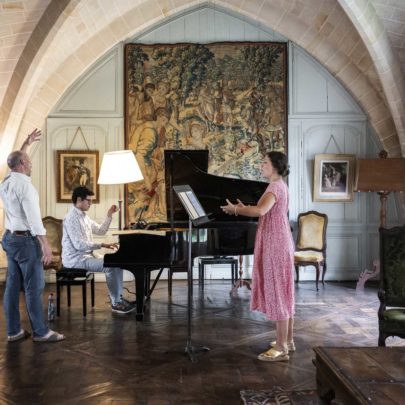
After exploring French Baroque opera in 2016, early 17th-century Roman opera in 2017, and subsequently Cesti’s Le Nozze in sogno and Legrenzi’s Eteocle e Polinice in 2018, Christophe Rousset returns to Royaumont for a workshop on Cavalli’s opera Orione.
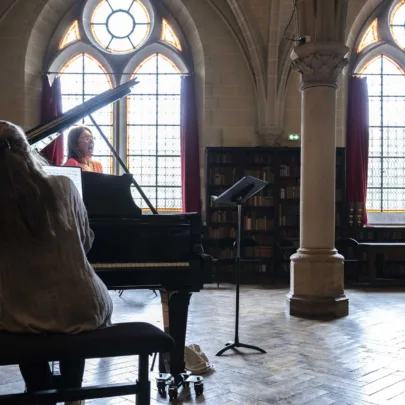
Together with vocal coach Brice Sailly, stage director Romain Gilbert, and language consultant Rita de Letteriis, they will work with ten singers, a harpsichordist, and an assistant director on Cavalli’s Orione.
Over the course of twenty days, the team will explore the rhetoric specific to this Venetian repertoire, focusing on aspects of declamation, dramatization, ornamentation, and vocal style.
Composed by F. Cavalli and premiered in Milan in 1653, Orione transports us to a world where ancient myth meets human passion. Inspired by the legendary figure of Orion—the famous hunter—F. Melosio’s libretto blends love and jealousy, playfulness and cynicism, free from conventional moralizing. Through expressive and refined music, Cavalli brings to life deeply human characters torn between their own feelings and forces beyond their control. The work’s beauty lies, perhaps, in this balance between the mythological marvelous and the intimacy of human emotion. Working alongside C. Rousset, singers and instrumentalists are invited to engage in meticulous work—focusing on both the music and the text—to reveal the full beauty of an unconventional work that has lost none of its innovative power nearly four centuries after its premiere.
Following the “Orione” campus, Les Talens Lyriques will act as the project’s executive producer, with a view to a planned tour during the 2027/28 season (tentatively scheduled for spring 2028). Engagement contracts will be negotiated directly between you and Les Talens Lyriques.
Encadrement
Founder of Les Talens Lyriques and an internationally renowned harpsichordist, Christophe Rousset is driven by a passion for opera and the rediscovery of Europe’s musical heritage. Trained by Huguette Dreyfus and later by Bob van Asperen in The Hague, he won First Prize at the prestigious Bruges Harpsichord Competition in 1983. At the helm of Les Talens Lyriques—which he founded in 1991—he performs worldwide, exploring Baroque, Classical, and pre-Romantic repertoires.
His career as a harpsichordist and chamber musician is marked by recordings made on the finest historical instruments; these are regarded as benchmark interpretations (notably his complete cycles of works by Bach and Couperin).
His extensive discography notably includes the complete tragédies lyriques of Lully.
He also engages in research and writing, producing critical editions and monographs dedicated to Rameau and F. Couperin.
A sought-after guest conductor, he works with numerous ensembles and has been associated with the Monteverdi Choir & Orchestra since 2024.
Committed to passing on his expertise, he has participated in the Royaumont Foundation’s training programs since 2016. Through intensive sessions focusing on composers such as Lully, Rameau, Legrenzi, Cesti, and Landi (including the opera La Morte d’Orfeo in 2017), young singers gain experience in meeting the demands of the operatic stage.
A Chevalier of the Legion of Honour, Commandeur of Arts and Letters, and Officier of the National Order of Merit, he received the Handel Prize in 2024 and the Premio Traetta in 2026.
https://www.lestalenslyriques.com/
Romain Gilbert initially studied piano and voice at the Paris Conservatory and trained as an engineer before turning to arts and cultural management. He holds a master’s degree in music management from the Sorbonne University in Paris. After gaining experience in artistic production, he shifted his focus to stage direction. He has worked as an assistant to renowned directors at various European venues, including La Monnaie in Brussels, the Royal Danish Opera in Copenhagen, Covent Garden, the Liceu, the Berlin State Opera, and the Aix-en-Provence Festival. As a director, his productions in Bordeaux have included La Périchole, Carmen, and Werther. He has also created semi-staged opera programs for the Salzburg Whitsun Festival, the Radio France Festival, the Enescu Festival in Bucharest, the Elbphilharmonie, and Baden-Baden. Recent directing credits include Carmen in Versailles, Hong Kong, Hanoi, Dallas, and Athens; La Gioconda in Naples and Barcelona; and Roméo et Juliette in Dallas.
www.romaingilbert.com
Brice Sailly harpsichordist and vocal coach
For many years, Rita de Letteriis has been searching for one of the essential keys to lyrical interpretation in the meaning and sensuality of poetry. The immense Italian repertoire of the 17th century is the crucial field, which she frequented alongside the performers who continue to explore it.
Accommodation and Services
During the training program at Royaumont, selected participants receive:
- Accommodation at Royaumont Abbey in a single room with a private bathroom;
- Meals prepared and served by the Abbey’s catering team;
- Group shuttle transfers between Viarmes train station and the Abbey upon arrival, on days off, and upon departure (schedules to be determined by the Royaumont team).
Student Testimonials
“It was a wonderful experience.”
“A great way to deepen my knowledge and understanding of the profession’s demands.”
“A fantastic opportunity to work on a role under conditions close to a professional production, and to meet wonderful people—both musically and personally.”


Terms and Conditions
Target Audience
- 10 singers
- 1 harpsichordist
- 1 assistant stage director
Distribution
- Orione > Soprano or contre-ténor
- Diana > Soprano
- Filotero > Baryton
- Venere > Contralto
- Amore > Contralto or soprano
- Apollo > Tenor
- Aurora > Soprano
- Ninfa I di Diana > Soprano
- Titone > Baryton
- Giove > Tenor
- Ambitus des rôles
Prerequisites and Admission Requirements
- Must be a professional singer or harpsichordist nearing the end of advanced studies.
- A good level of Italian is desirable.
- Participants formally commit to attending the entire training program.
Schedule
- Monday, July 12: Arrival and welcome (late afternoon/evening)
- Tuesday, July 13 – Sunday, July 18: Group and individual sessions
- Monday, July 19: Day off
- Tuesday, July 20 – Sunday, July 25: Group and individual sessions
- Monday, July 26: Day off
- Tuesday, July 27 – Saturday, July 31: Group and individual sessions
- Departure: Evening of July 31 (limited exceptions possible for the morning of August 1)
Duration: 19 days (including 2 days off). Total hours: 119 hours.
Public Presentation
“Plein feu” (Showcase): July 31, 2027, at 3:30 PM
No remuneration is provided for this presentation.
Following the “Orione” campus, Les Talens Lyriques will act as the executive producer for the project, aiming for a tour during the 2027/2028 season (tentatively scheduled for spring 2028). Engagement contracts will be negotiated directly between you and Les Talens Lyriques.
Prices
€2,800 (incl. tax) (registration fee = €400 incl. tax + contribution to costs = €2,400)
Application
Pre-selection based on application materials, followed by an audition
Application review by the teaching staff
- Cover letter
- Short biography (600 characters, including spaces)
- CV
- Photo (max. 100 MB)
- One or more video files relevant to the chosen course (please note: WeTransfer links will not be downloaded)
To be presented at the audition:
- 1 recitative and 1 aria from an Italian opera (17th century)
Schedule
Application submission
Application deadline: November 1, 2026, at midnight
- Step 1: Pre-selection based on application materials
- Notification: From November 30, 2026
- Step 2: Shortlisted candidates will be invited to a two-day audition on January 26 and 27, 2027, in Paris
- Final decision: From mid-February 2027
All training programs offered by the Royaumont Foundation have a minimum lead time of 11 working days.
Example: If the Royaumont Foundation approves a registration request on June 14, it can offer the participant a training course starting on June 29.
Program Overview
Version 1 (dated 21/09/2026)
Validity period for Version 1: 1 year (renewable)
Training Outline/Content
| Day 1 | Afternoon: welcome for beneficiaries and supervisors. Presentation of the Royaumont Campus and Foundation. | Presence of beneficiaries, supervisors, and Stage Unit teams |
| Weeks 1, 2 and 3 | Morning: Musical and/or staging work Afternoon: Musical and/or staging work | Sessions led by instructors |
Minimum/Maximum Group Size
Minimum group size: 10 artists
Maximum group size: 12 artists
Objectifs pédagogiques
Connaissances
- Comprendre un texte chanté et parlé dans sa signification littérale aussi bien que dans son sous-texte
- Intégrer la prononciation des textes chantés et parlés dans sa langue maternelle aussi bien que dans des langues étrangères
- Définir le contenu dramaturgique d’une œuvre
- Mémoriser différents rôles dans l’opéra pour pouvoir se détacher de la partition
Savoir-faire
- Répéter avec efficacité un programme dans un temps limité
- Trouver sa place musicalement et humainement dans un groupe
- Acquérir les outils techniques nécessaires à l’interprétation d’un répertoire et les mettre en pratique
- Prendre en compte les informations données par un.e musicologue spécialiste d’un répertoire pour affiner son interprétation d’une œuvre
Savoir-être
- Entendre et comprendre les demandes des encadrants et leurs suggestions musicales
- Exprimer clairement ses intentions musicales et scéniques et pouvoir les justifier
- Partager son interprétation avec un public lors de la restitution finale
- S’adapter aux exigences d’un répertoire (prononciation, musicalité d’une langue, jeu théâtral…)
Compétences visées
A l’issue de la formation le bénéficiaire sera capable de :
- Interpréter l’opéra « Orione » de Cavalli
- Aborder les spécificités du travail scénique avec le metteur en scène Romain Gilbert
- Travailler sur les particularités de la musique de Cavalli avec le claveciniste chef de chant et le coach d’italien
- Apprendre la mise en jeu du chanteur sur le plateau
- Se préparer à des productions lyriques dans un contexte professionnel
Methods employed
Teaching methods:
Individual and group lessons, held in person.
Lessons are conducted in French and, where applicable, in Italian and English.
One or more public presentations will take place during the residency at Royaumont or at off-site venues. These involve all participants and are unpaid.
Technical resources provided:
The rooms are spacious and equipped with music stands (solid or folding), chairs or stools suitable for musicians (arm-free), and the instruments required for the training.
Participants must bring their own instruments and sheet music, as these are not provided.
Outside of scheduled lesson times, rehearsal spaces may be made available free of charge, upon request and subject to availability.
The entire Abbey complex (rooms and gardens).
Documentation via Drive privé.
Modalités de suivi et d’évaluation
Pendant la formation en présentiel
- Évaluation par le travail pratique du bénéficiaire, de sa réactivité et son aptitude à intégrer les propositions faites par les intervenants.
- Pendant la restitution à la fin de la formation : l’interprétation de l’œuvre devant un public qui permet d’apprécier l’évolution de l’interprétation et la capacité du bénéficiaire à présenter son travail en spectacle.
Les bénéficiaires signent une feuille d’émargement par demi-journée.
En fin de formation
Une attestation de fin de stage mentionnant les objectifs, la nature et la durée de l’action et les résultats de l’évaluation des acquis de la formation est remise au bénéficiaire ainsi que le certificat le cas échéant.
Modalités d’évaluation qualitative
Au dernier jour de la formation, le bénéficiaire remplit une fiche d’évaluation qualitative afin d’évaluer les acquis de la formation d’un point de vue artistique, pédagogique, humain et matériel.
Accessibilité et prise en compte des situations de handicap
La Fondation Royaumont fait de l’accueil et de la participation des personnes en situation de handicap un engagement fort de son projet. Nos formations sont ouvertes aux personnes en situation de handicap et différents aménagements peuvent être envisagés en fonction des spécificités de chaque formation. Afin d’échanger sur vos besoins, contactez-nous au moment de votre inscription ou veuillez contacter les référents handicaps.
Contacts
Educational Coordinator
NN, Artistic Director of the Voice & Repertoire Department and the Stage Unit
François Naulot and Catherine Huet (Acting)
Administrative Coordinator
Catherine Huet Administrator for the Voice & Repertoire Department and the Stage Unit
huet.c@royaumont.com
Logistics Coordinator
Armelle Mousset Production Manager for the Voice & Repertoire Department and the Stage Unit
Référents handicap
Samuel Agard et Doriane Trouboul
referenthandicap@royaumont.com
Référent VHSS
vhss@royaumont.com